Sonntag, 3. Oktober 2010

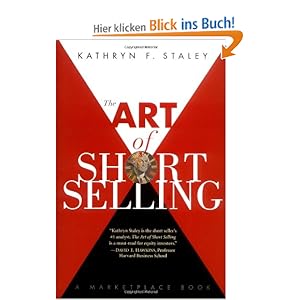
Book Review: "The Art of Short Selling"


I was really looking forward when I opened the Amazon package. This was touted as one of the "Must Reads" for anyone interested in short selling.

However, after having it read now, I am actually quite dissapointed. The book starts with a small introduction and short portraits of some famos short sellers which was interesting.

However, then in the next 200 pages there is example after example of stocks which at some point in time crashed due to different reasons.

SOme of those examples were quite interesting, however most of them were relatively short descriptions with some charts and a quick story.

The best part of the book are the last 50 or so pages which summarize what and where to look for if you want to spot porential short candidates. In contrast to other books however, the content is relatively "shallow".

For me the book was quite hard to read, as the examples do not really comprise a story. All in all something you may read but it is definitely not a "must Read".

Samstag, 25. September 2010

Asian Bamboo part 2

As discussed in post 1,Asian Bamboo is rapidly growing and extremely profitable.

A quick look at the press relase for Q2 2010 shows astonishing margins:

  • Revenue: up by EUR 12.9 million (50%) to EUR 38.7 million (2009: EUR 25.8 million)
  • Gross profit margin: three percentage points higher at 52% (2009: 49%)
  • Adjusted net profit: up by EUR 8.1 million (63%) to EUR 21.1 million (2009: EUR 13 million)
  • Adjusted net profit margin: four percentage points higher at 54% (2009: 50%)
Interestingly enough net Profit margin is higher than gross profit margin, but anyway 50% margin is something you don't see often.

One could think that a company with this margins could finance any growth out of current cashflow, however the company made one capital increase October 2009:

Hamburg, 22 October 2009. With reference to the Company's announcement of 21 October, Asian Bamboo AG (ISIN: DE000A0M6M79; ticker symbol 5AB“, "the Company") is pleased to announce that it has successfully placed 1,275,000 new shares in a private placement at an issue price of EUR 20 per share to institutional investors by way of an accelerated bookbuilding process on 22 October managed by Sal. Oppenheim as Sole Bookrunner and M.M. Warburg as Joint Lead Manager

And another one 9 months later in June 2010:

Release of an Ad hoc announcement according to Sec. 15 German Securities Trading Act (WpHG) / Capital Increase – Not for release, publication or distribution in the United States, Canada, Japan and Australia

Hamburg, 17 June 2010, with reference to the Company’s ad hoc announcement of 16 June 2010. Asian Bamboo AG (“Asian Bamboo”, the “Company”) today successfully completed the private placement of 2,400,000 shares. The shares were allocated to institutional shareholders at a price of EUR 31 per share by way of an accelerated bookbuilding process.

The private placement will provide Asian Bamboo with gross proceeds of EUR 43.4 million, to be used to partially finance leases of 10,733 ha of bamboo plantation. The Company has resolved a capital increase out of its authorised capital and will issue 1,400,000 new ordinary bearer shares with a pro-rated amount in the share capital of EUR 1.00 each, which will increase the Company’s share capital from EUR 14,025,000 to EUR 15,425,000. The pre-emptive rights of the existing shareholders were excluded in the capital increase.

In both cases, the majority owner (and CEO) used the opportunity to lower his share holdings.

In 2009, the CEO could pocket a cool 7.5 mn EUR:

Due to strong and high quality investor demand substantially exceeding the offered shares, an over-allotment of 191,250 shares (“the greenshoe”) and an additional 308,750 shares (“the placement”) were placed by Green Resource Enterprise Holding Ltd ("Green Resources"), a company wholly owned by Mr. Lin Zuojun - the founder and CEO of Asian Bamboo.

Plus an even cooler 31 million in 2010 (hint: in the press release above you have to subtract the 2.4 mn shares total placement minus the 1.4 mn new shares and multiply with 31. The result was that

As a result of the private placement, Green Resources’ shareholding in Asian Bamboo has decreased to 5,760,700 shares. Once the capital increase is completed, the total number of outstanding shares will increase to 15,295,100 (excluding treasury shares). Consequently, Green Resources’ ownership of the Company will decrease from 48.7% to 37.7%, which means that the free float will increase from 51.3% to 62.3%.

Any corporate financier would ask himself: Why do those guys issue new shares ? They should get any loans they need or ven finance this with their operating cashflow ? Why diluting the shareholders so massively all the time ?

But for now we stay with FINDING NR. 2:

Despite massive margins, company issues continiously new shares

and FINDING NR. 3:

The CEO as ultimate Insider is cashing out massively


To be continued......

Asian Bamboo part 1


I am following Asian Bamboo since a while. The stock was IPOed in Frankfurt at the end of the 2003-2007 bull run mid November 2007 at 17 EUR.

The company is a Chinese company with a Frankfurt stock listing, no direct US or Chinese/Hongkong Listing.

However, since some time DB sponsored ADRs are trading under the Ticker ASIBY (ADR) in the US.

The company's web site (http://www.asian-bamboo.com/index.asp) states:

The origins of Asian Bamboo AG can be traced back to 1992 when Mr. Lin Zuojun, the CEO and founder, started a bamboo trading business in Fujian province. The business grew rapidly and Mr. Lin built our first bamboo processing plant, located in Mawei, in 1997. In the late 1990s, there was only limited demand for processed bamboo shoots in China, so the Company focused on the Japanese market where we were one of the pioneers in developing the distribution of Chinese processed bamboo shoots. Japan was for many years our most important market until domestic demand took off in the early 2000s. In 2001, we leased our first plantation and since then fresh bamboo shoots and bamboo trees have developed into our largest product categories.

Asian Bamboo AG was incorporated in Hamburg and listed on the main board (Prime Market) of the Frankfurt Stock Exchange, under the ticker symbol “5AB”, on 16 November 2007. Using the proceeds from the IPO, we leased more than 10,000 ha of mature plantations in 2008, which instantly more than doubled the size of total mature plantations from the year before.

The companie's stock was hammered in 2008&2009 but tenfolded since March 2009 to a new top auf 40 EUR on 24.09.2010

The company has 15,425,000 shares outstanding, so the total market cap is now a cool 620 mn EUR.

Profit Growth has been extremely strong. The website shows the 3 years since the IPO:


2009

2008

2007

Revenue

K€

58,621

43,831


14,748

Adjusted net profit1

K€

27,847

21,193


6,748


Both revenue and Profit almost quadrupelt in the three years from 2007. But what does footnote 1) mean ?

1 Adjusted for changes in the fair value of biological assets and taxes thereon

Aha, that's new for me. They adjust profit for "changes in the fair value of biological assets"...Interesting...


Lets directly jump into Annual Report 2009 to the Balance sheet on Page 65:


"Biological Assets" are 128 mn EUR or more than sixty percent of total equity (200 mn EUR).

Footnote 2.6. of the General accounting policies on page 70 tells us the following:

Therefore, inline with current practice, we have chosen to value our immature plantations by the cost of cultivattion and mature bamboo plantations based on a computation of the present value of expected cashflows according to IAS 41.10, 41.21 and the assumptions used in this calculation.

So let's just understand this: The company

-capitalizes costs for cultivation

-already recognizes future salses of Bamboo to a certain extent


Before we dig deeper into this, the following passage in the Q2 Report on page 7 caught my eye:

Biological Asset Accounting
We are currently in discussion with our auditors about the methods of determining the fair value of biological assets.........we expect that any changes ..... will not have an material impact on the revenue or the adjusted profit numbers.

NOW THIS IS INTERESTING !!!!!

As they are adjusting their profits anyway, there will be certainly no bis issues for those profits, but this certainly means that a large art of the biological assets will most likely dissapear and with that a lot of equity !

Sell side analysts will of course tell us that this doesn't matter, but I would call this:

FINDING NUMBER 1:

Aggressive ( capitalizing expenses, recognizing future sales) and obscure accounting, soon to be restated


To be continued


Stutz Corner 1923

One of the greatest short squeezes in history engineered by the owner of the Stutz company and notorious "Stock Operator" in the early 1920s

A short excerpt can be found here:

http://www.newyorker.com/archive/1969/08/23/1969_08_23_074_TNY_CARDS_000296736


and here

http://www.time.com/time/magazine/article/0,9171,711717,00.html


Excerpt from the Time article:

A notable feature of the early 1920's was the Stutz Bearcat, a fast & flashy automobile that rode, looked, and sounded like a racing car. About the same time that Bearcats were reaching the peak of playboy popularity, Stutz Motor stock provided some excellent advertising by rising in a brief period from $70 per share to $724. That was the notorious "Stutz Corner" engineered by Allan Ryan, son of the late Thomas Fortune Ryan who in his will cut off his speculative heir with a set of pearl studs.

Chanos is still short China

and for profit education companies:

http://www.bloomberg.com/news/2010-09-24/chanos-remains-short-for-profit-education-stocks-cites-graduate-salaries.html


Oh and by the way as this is the first post on Chanos his bio on wikipedia:

http://en.wikipedia.org/wiki/James_Chanos

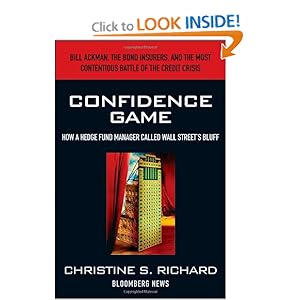
Book Review: Confidence Game


An interesting book which describes the fight of another Hedgefund hot shot, namely Bill Ackman against another financial company MBIA.

Already in the early 2000s, Bill Ackman came to the conlusion that the business model of the so called "Monoline" Insurance companies made no sense and started shorting the stock and critize it openly.

What followed was a huge backlash from the company the SEC and even Elliot Spitzer, then Attorney General in New York.

The story is well told, however there is one drawback: Different to Einhorn's Book "Fooling some people all the time", this book was written by a journalist and not by Ackman himself. It therefore doesn't offer the same insight into the "thinking" of the genius. But it is still a worthwile read and highly recommended for anyone interestes in short selling.

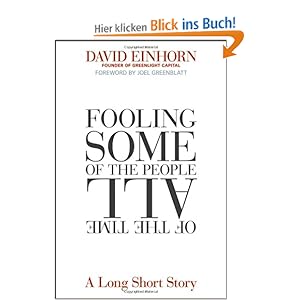
Book Review: "Fooling some people all the Time"


This is the ultimate short selling case study of one of the most respected Hedgefund and Value Investors of our time.


It describes the year long crusade of David against the Management of a almost criminal financial services companyAllied Capital). As it is written by himself, it shows his style of analysis which combines highly sophisticated balance sheet analysis and extensive field research.

It also shows in detail, how much resistence he was facing, not only from the Company itself but also from angry investors, the SEC and others. The company tried to put any kind of preasure on him, like even spying on his telephone calls.

Besides the analytical angle, the book also shows the absolute will of EInhorn to fight this through. At some point in time he even commits all potential profits out of this position to charity.

I would actually recommend it also as an outstanding book on analyzing financial statements for anyone interested in this field.

And of course this is a Must Read for anyone interested in short selling stocks.

Lets start with something entertaining

As this shall be a collection of past case studies, current short opportunities and general information about selling stocks short. But before we start, let us look something entertaining:

Randy Nemwan's "Short People"


I think this Song must have been sponsored by Wallstreet or by some company IR person.

"They got grubby little fingers
And dirty little minds
They're gonna get you every time
Well, I don't want no Short People
Don't want no Short People
'Round here"